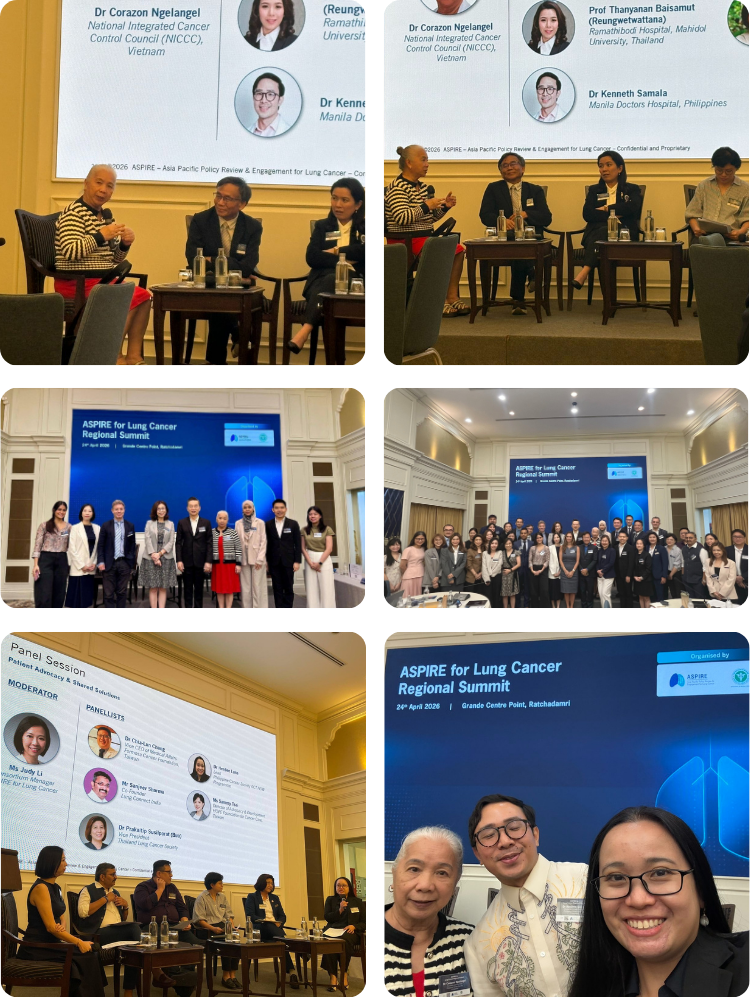

Official Summary of Participation and Strategic Alignment
Organization: Philippine Cancer Society (PCS)
Event: ASPIRE Regional Summit 2026 – “From Consensus to Action”
Executive Representation
The Philippine Cancer Society (PCS) maintained a prominent presence at the summit, represented by its most senior leadership and technical experts to ensure the Philippine context was central to Asia-Pacific (APAC) lung cancer policy.
- Dr. Corazon Ngelangel (President, PCS): Served as Panel Moderator for Session 5: Funding Models & Access to Treatment. Dr. Ngelangel facilitated critical discussions on Public-Private Partnerships (PPPs) and innovative risk-sharing models to improve patient access to innovative therapies.
- Dr. Herdee Luna (Lead, PCS ACT NOW Program): Served as a Featured Panellist in Session 3: Patient Advocacy & Shared Solutions. Dr. Luna presented the "ACT NOW" framework as a scalable model for embedding patient voices directly into health policy and care delivery.
- Dr. Kenneth Samala (University of the Philippines-Philippine General Hospital): Represented the Philippine clinical perspective in the panel on Funding Models, bridging the gap between clinical necessity and financial sustainability.
- At the Session on “Global Perspectives on Translating Consensus into Action”, Dr Ngelangel gave the following insights, focusing on the Philippines:
The most lung-cancer–specific KPI for financial fairness would be a measure of catastrophic health spending among patients who receive guideline‑concordant modern therapy – i.e., financial fairness, operationalized in practice as Coverage KPI (access to innovation) and Financial Toxicity KPI (fairness/protection), stratified by income and geography. The government's role is to use financing, regulation, and service delivery reforms (under UHC and NICCA) to drive down that financial toxicity while expanding access to biomarker‑driven and other innovative treatments nationwide. For a fuller lung cancer policy scorecard, the core KPI above can sit on top of a small set of upstream and downstream indicators (respectively - proportion of NSCLC patients who receive guideline‑recommended biomarker testing (EGFR/PD‑L1) at diagnosis, by facility type and region, share of total lung cancer treatment costs for standard regimens (chemo‑IO, targeted therapy) that is publicly financed (PhilHealth + DOH Cancer Assistance Fund + Medicines Access Program), time from regulatory approval and HTA recommendation to public reimbursement/PhilHealth package inclusion for new lung cancer medicines, AND rate of treatment discontinuation or non‑initiation in eligible patients due to cost, documented in EMR or navigation notes, prevalence of moderate‑to‑severe financial toxicity among lung cancer patients and caregivers at 6 and 12 months from diagnosis, based on standardized tools, patient‑reported outcomes (e.g., quality of life, distress) linked with financial counseling or navigation support.
Given the Philippine context under UHC and NICCA, the government’s role is multi‑layered: regulator, purchaser, and steward of the cancer system - Strengthen pooled public financing for high‑value, innovative lung cancer care, Accelerate and align HTA, regulatory approval, and reimbursement, Invest in service delivery infrastructure beyond NCR, Protect patients and families from financial toxicity, Enable multi‑stakeholder governance and data systems
Government commitments (e.g., expanded PhilHealth lung cancer packages, bigger Cancer Assistance Fund, regional cancer center investments) can be explicitly tied to movement in these indicators over time, making “financial fairness in access to innovative lung cancer treatment” something you can monitor and hold the system accountable for.
Executive Summary
The Philippine Cancer Society (PCS) participated as a key strategic partner in the ASPIRE Regional Summit 2026, a high-level assembly of health policy leaders, clinicians, and patient advocates from across the Asia-Pacific. The Summit focused on transforming the APAC Lung Cancer Policy Consensus into measurable health system improvements. The PCS participation centered on localized implementation of regional goals, specifically through the "ACT NOW" framework and the empowerment of the patient voice in the Philippine healthcare landscape.
Summit Highlights
1. Patient Advocacy & Shared Solutions
In the panel session dedicated to patient advocacy, Dr. Herdee Luna emphasized that lung cancer outcomes only improve when health systems act across the full patient journey.
Strategic Input: The PCS advocated for the transition from "pockets of excellence" to a unified, person-centered national grid.
The "ACT NOW" Manual: The PCS shared insights from the ACT NOW Startup Operations Manual, highlighting how local implementation commits to screening, early detection, and navigating patients through fragmented health systems.
2. Access to Advanced Diagnostics
The PCS delegation participated in high-level reviews regarding the regional disparity in biomarker testing and Next-Generation Sequencing (NGS).
Key Advocacy: Representing the Philippines, the PCS underscored the need for standardized diagnostic pathways to ensure that innovative treatments—for both NSCLC and SCLC—are supported by timely and affordable testing.
3. Sustainable Financing & Policy Alignment
Under the moderation of Dr. Corazon Ngelangel, the summit explored how health systems can balance the cost of innovative therapies with long-term sustainability.
PCS Position: The society highlighted the importance of aligning regional ASPIRE recommendations with national frameworks like the National Integrated Cancer Control Act (NICCA) and PhilHealth NGO strategies.
Key Strategic Pillars
1. Integrating Early Detection into National Programs
The Summit identified a regional gap in the integration of lung cancer screening into national health systems.
2. Advancing Precision Medicine and Biomarker Access
Discussions underscored that access to advanced diagnostics (NGS and biomarker testing) remains uneven across the region.
3. Elevating the Patient Voice in Policy Design
A core theme of ASPIRE 2026 was the strategic integration of patient organizations into policy-making.
4. Sustainable Financing and Public-Private Partnerships (PPP)
The Summit explored innovative funding models to balance patient access with health system sustainability.
The "ACT NOW" Implementation Commitment
During the Summit, the PCS reaffirmed its commitment to the "ACT NOW" (Action Now) Startup Operations Manual. This framework directly addresses the Summit’s call for:
Coordinated Pathways: Reducing the "time-to-treat" through streamlined referral systems.
Clearer Accountability: Defining the roles of community health workers and oncologists in the lung cancer journey.
System Resilience: Building a local health infrastructure that can sustain screening efforts beyond isolated medical missions.
Conclusion and Forward Outlook
The participation of the Philippine Cancer Society at ASPIRE 2026 signals a shift from purely clinical advocacy to health system leadership. By aligning national initiatives with Asia-Pacific regional standards, the PCS ensures that the Philippines is not just a participant in global cancer policy but a leader in its practical, community-based application.
"Lung cancer outcomes will not improve through isolated interventions alone. Through our participation in ASPIRE, the Philippine Cancer Society reinforces its mission to integrate every step of the patient journey into a single, unbreakable chain of care."
Prepared by: The Executive Action Team – Oncology
Philippine Cancer Society
May 2026